


The best guide to visiting the Sagrada Familia during Holy Week: what to see, updated opening hours, time-saving tips and essential recommendations
Barcelona celebrates Holy Week (March 29 to April 6, 2026) with its own unique blend of liturgy, culture, and light. At its heart: the Sagrada Familia, which this year takes on even greater significance due to Gaudí's centenary and the milestones of 2026. Here's everything you need to plan your visit and enjoy it like a local, with helpful tips. insider and details that almost no blog mentions.
There are special years to visit the Sagrada Familia… and then there's 2026, a year where history, emotion, and architecture intertwine like few others. It's hard to imagine that the architect who dreamed up this stone forest was killed by a tram and that, for hours, no one knew who that injured old man was. But a century later, his work continues to grow as if he were still there, drawing plans and adjusting models.
Holy Week amplifies that contrast between life and death: while the Passion Façade is illuminated with a visual narrative about the last hours of Jesus, all of Barcelona pays homage to the architect who forever changed its urban landscape.
In this article you will discover:
– Why 2026 is a unique year to visit the Sagrada Familia
– What special events give Holy Week its strength?
– The historical and religious background of Palm Sunday Mass, the Triduum, and the Stations of the Cross
– Secrets of the temple that often go unnoticed, even by Barcelonans
– And how to experience it without queuing, with a deeper understanding of the temple
Here you have it Complete guide to all activities at the Sagrada Familia during this Holy Week
1) The most anticipated: free light show on the Passion Façade
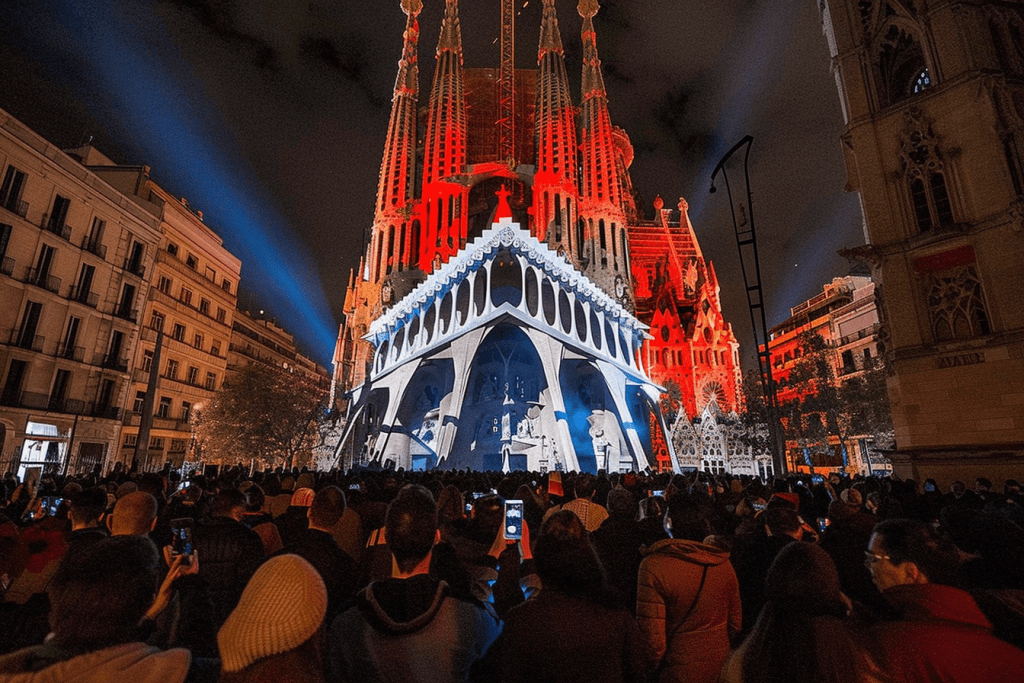
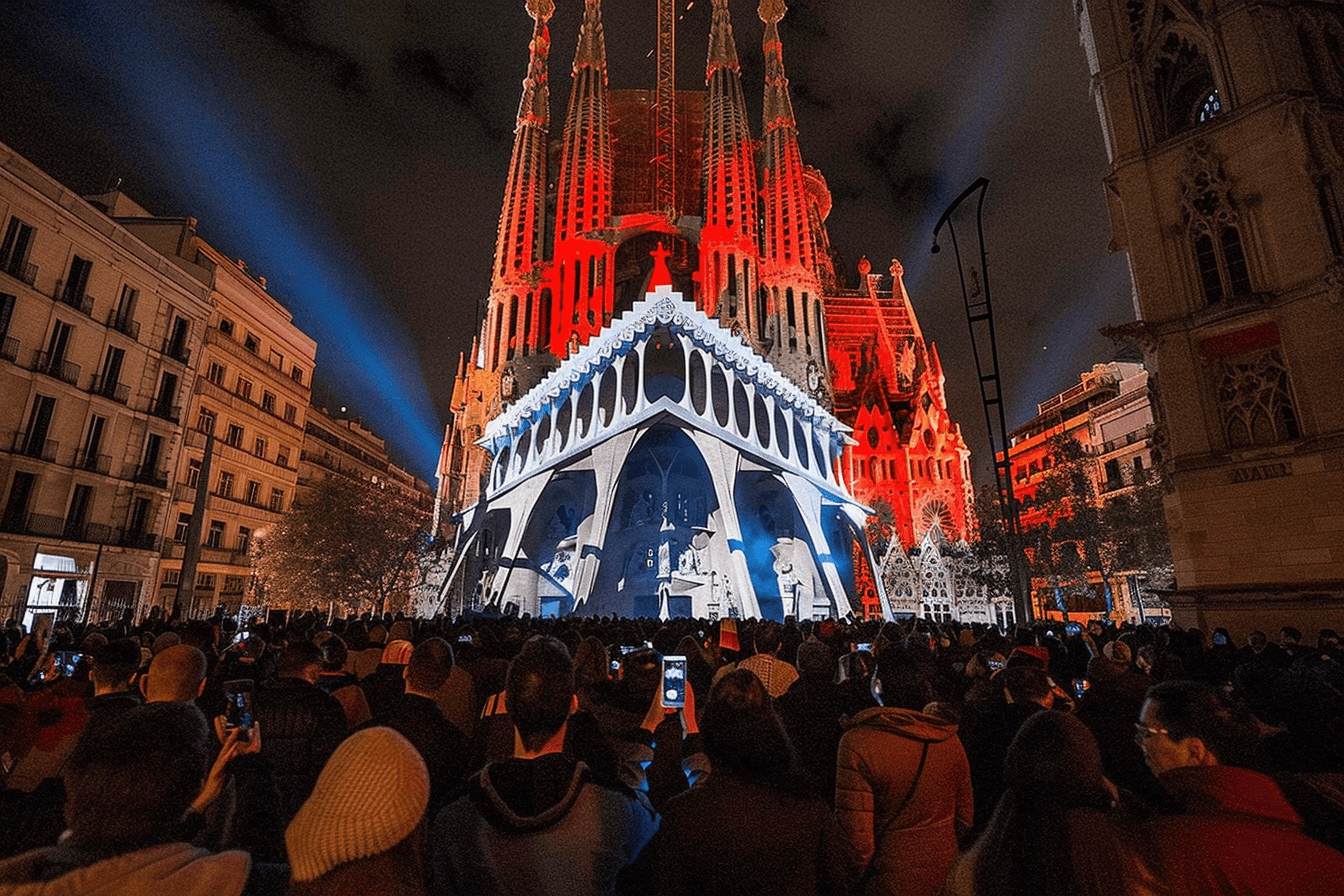
Dates and times: March 29, 30 and 31 with two passes nightly: 21:00 and 21:30 (alternating between Catalan and Spanish). It is a visual and musical narrative of the Passion and death of Jesus, based on texts by Bishop Antoni Vadell. Free access from Sardenya Street. It lasts about 25 minutes per pass.
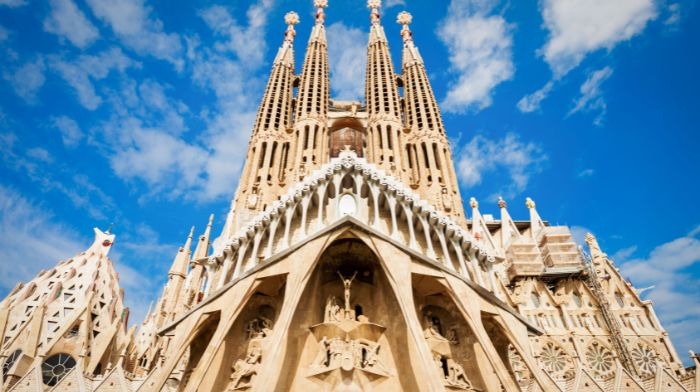
Guide tip: the The Passion façade faces west; If you arrive with time to spare, take advantage of it. light of the sunset to see how the elongated shadows "sculpt" the scenes before the show. The very concept of this facade is designed to "frighten" and convey austerity: stark planes, columns that resemble bones, and an "S"-shaped layout of scenes.
2) Special Holy Week programming (days and presidencies)
- Palm Sunday Mass: March 29, chaired by Monsignor Javier Vilanova (Auxiliary Bishop). Palm Sunday Mass commemorates Jesus' triumphant entry into Jerusalem. It is a day that blends joy and drama: Jesus is received as king, but the liturgy already anticipates the Passion. It is the solemn and symbolic beginning of Holy Week. All celebrations in the Basilica will be broadcast by streaming HERE
- Easter Triduum: April 2nd and 3rd (Mons. David Abadías) and April 4 (Mons. Javier VilanovaThe Easter Triduum is the heart of the entire Christian calendar. Holy Thursday commemorates the Last Supper and the washing of the feet; Good Friday invites us to silence and contemplate the death of Christ; and the Easter Vigil on Saturday is the most important celebration of the liturgical year, where darkness gives way to the Resurrection.
- Stations of the Cross: April 3. The Stations of the Cross reenact Jesus' journey to Calvary, station by station. More than a procession, it is a spiritual exercise that invites us to accompany Christ in his suffering. At the Sagrada Familia, it takes on a special meaning, connecting with the stark expressiveness of the Passion Façade, designed to convey the intensity of the sacrifice.
Consultation changes and capacities in the temple's official schedule. Some events may affect access and opening hours.
3) Family plan: Children's Easter workshop (March 21 – April 6)
For boys and girls of 6 to 12 years: a dynamic visit focusing on the Passion facade and decorating a chocolate figure inspired by the terminal of the Cross of the Tower of Jesus. Price: 9 € per person (adults and children 6+). Advance booking required.
4) 2026: the year of Gaudí's centenary (and why it matters to your visit)
2026 This is no ordinary year to visit the Sagrada Familia: it's a historic year. Barcelona commemorates the Gaudí Centenary, And understanding how the architect died allows us to understand why his figure remains so present in the city.
Gaudí died on June 10, 1926, after being hit by a tram on the Gran Via de les Corts Catalanes. His humble appearance led many to mistake him for a beggar. He was taken to the poorhouse of the old Hospital de la Santa Creu without anyone knowing who he was. Hours passed before someone recognized him and relayed the news to the Sagrada Familia. By then it was too late: Gaudí died the following day. An anonymous farewell for the man who was building Barcelona's most monumental temple.
In our article dedicated to the centenary (“100 years without Gaudí and the genius who is still building Barcelona”) we explain why, a century later, his legacy lives on in every stone, every tower, and every architectural decision of the temple:
That's why 2026 This is the year to come:
– Gaudí Centenary: The city and the Sagrada Familia have prepared commemorative events, celebrations, exhibitions and activities that will never be repeated.
– Temple progress and milestones: 2026 coincides with progress linked to the Tower of Jesus Christ and with activities of the Gaudí Year, a crucial moment in the construction progress of the basilica.
Secrets of the Holy Family that almost no one tells you about
A) Gaudí's tomb: where it is and how to see it without getting lost
Gaudí is buried in the Crypt of the Holy Family, in the chapel of Our Lady of Mount Carmel. Access is usually signposted as “Crypt / Crypt of Carmen” from the inside and can to close during liturgical acts; Look for a quiet time slot (first or last of the day).
Quick route: integrates the crypt within your interior visit; Leave the descent for the final stretch, dedicate 10–15 min to orient yourself and maintain a brief silence before Gaudí's gravestone.
B) The Sagrada Familia as a musical instrument (Gaudí's acoustic vision)
Gaudí didn't just think about stone and light: He conceived the temple for singing. He wanted choirs around the enclosure, located at 15–20 meters on the ground so that the hyperbolic vaults acted as “loudspeakers”, spreading the voice throughout the ship. There were even separate spaces for female choirs, treble voices and a musical chapel under the central dome.
Why you might be interested: Understanding this "stone orchestra" changes the way you listen to any mass or concert in the basilica. (If you're passionate about acoustics, there are informative analyses that discuss...) sound itineraries in Gaudí's work).
C) The fossilized “Easter egg” of the Passion
In the group of the Flagellation (Passion Façade), fix your gaze on the stone: There is a real fossil integrated into the block, a detail that often goes unnoticed.
D) The “stormtroopers” of Subirachs
The helmets of some soldiers They resemble chimneys of The Quarry; a nod much discussed by art historians that connects the iconography of the Passion with other works by Gaudí.
E) The turtles of the Nativity scene that hold up time
In the Nativity facade, two turtles (a land and another marine) they maintain the central columns: they symbolize the unchanging nature of time (land and sea, the firm versus the change), a very fine detail of the symbolic program.
Pro tips for your visit (and how to avoid queues)
Did you buy "temple only" but want to climb towers?
He official supplement because of the rise to a tower It's from 10 € Regarding the basic entrance fee (the “temple + tower” package costs 36 € facing 26 € the basic one). Sometimes can manage the supplement on site (subject to availability) at the Information Point on the Passion Façade. My recommendation: ask there; If there's space available, they'll process it for you. add-on.
Where and when to position yourself for the light show
- Arrives 30–40 min before and search frontality to the Passion (Sardinia). The first pass It usually has slightly less density than the second one.
- If you like photography, the previous twilight The first pass will give you a gift long shadows and extra volume in the sculptures.
HL Agenda: Everything to do each day at the Sagrada Familia (practical summary)
- March 21 – April 6 · Family workshop (+ chocolate) · 9 € ·
- March 29, 30, 31 · Light show in the Passion · 21:00 and 21:30 · Free.
- March 29 · Palm Sunday Mass (Monsignor Vilanova).
- April 2, 3 and 4 · Easter Triduum (Mons. Abadías / Mons. Vilanova).
- April 3 · Stations of the Cross.
Official Calendar with latest updates and cuts for liturgy, here.
Experience the Holy Family like no one else does.
Our skip-the-line indoor tours are not "just another guided tour": they are the most complete, efficient and in-depth way to discover the temple from the inside, without rushing, without waiting and with the freedom to explore everything Gaudí imagined... and what is still being built a century later.
Why is our tour different?
– Tickets includedYou don't worry about anything.
– Personal radio guides to hear everything without missing a detail.
– Private guided tour of 1h 30 min, with the possibility of extending it by an extra 30 minutes if you want to go into more detail.
– Fast access without queues, You'll literally get in ahead of everyone else.
– Unlimited stay indoors After the visit: you can stay inside for as long as you like.
– Museum access included to complete the experience.
Discover why Gaudí continues to build Barcelona even a hundred years later and Book your experience here.